
1. Talk Therapy: The Power of the Narrative
This is what most people picture. It’s the “how does that make you feel?” approach, but modern talk therapy is much more collaborative and active than the old-school movies suggest.
- The method: We look at the stories you tell yourself. We dig into patterns, family dynamics, and the “why” behind your current reactions. It’s very much a language-based process.
- What it feels like: It feels like a focused, deep conversation where you have someone else’s full attention to help you untangle your thoughts.
- What the research says: According to the American Psychological Association (APA), the “therapeutic alliance” (basically, how well you and your therapist get along) is often a bigger predictor of success than the specific method used.
- In practice: A client might come in feeling “stuck” in their career. Through talking, they realize they are recreating a dynamic they had with a parent. Once it’s named, it loses its power.
2. EMDR: Moving Past the “Stuck” Moments
EMDR (Eye Movement Desensitization and Reprocessing) isn’t about talking your head off. It’s about how your brain stores memories.
- The method: When something scary or stressful happens, the memory can get “locked” in your nervous system in its raw form. We use “bilateral stimulation” (like following my fingers with your eyes) to help your brain process that memory so it feels like a thing of the past, rather than a current threat.
- What it feels like: It’s more structured. You don’t have to describe every painful detail out loud; your brain does the heavy lifting internally while you follow the movement.
- What the research says: The National Institutes of Health (NIH) recognizes EMDR as a highly effective way to treat PTSD. It’s proven to help people “file away” traumatic memories that previously felt unmanageable.
- In practice: Think of someone who was in a car accident and still tenses up every time they hear tires screech. After EMDR, they still remember the accident, but the physical “jolt” in their chest is gone.
3. Brainspotting: Where You Look Matters
Brainspotting is a newer tool that works on the idea that “where you look affects how you feel.” It goes straight to the subcortical brain, the part that doesn’t speak in words.
- The method: I help you find an eye position that links up with a physical or emotional “charge” in your body. We hold that gaze, allowing your nervous system to self-regulate and release tension.
- What it feels like: It’s often very quiet. You might find yourself staring at a specific point while noticing sensations in your body. It’s deep, focused, and often very surprising.
- What the research says: While it’s newer than EMDR, preliminary studies suggest it’s excellent for things like anxiety and “stuckness” that don’t respond well to just talking.
- In practice: A person might feel a “knot” in their stomach whenever they have to speak in public. By holding a specific “brainspot,” that physical knot might finally start to loosen and dissipate.
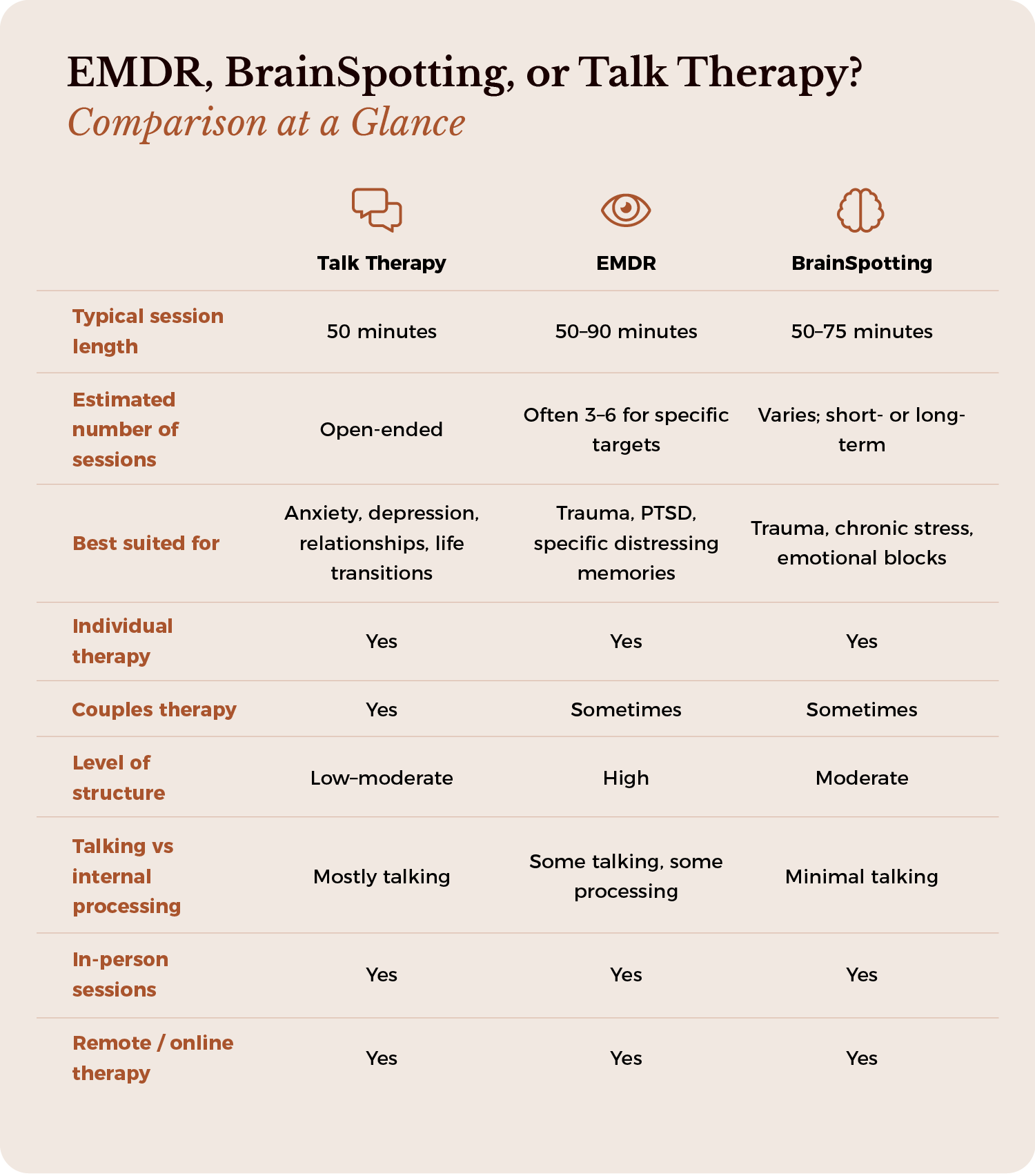
Comparison at a Glance
| Talk Therapy | EMDR | BrainSpotting | |
|---|---|---|---|
| Typical session length | 50 minutes | 50–90 minutes | 50–75 minutes |
| Estimated number of sessions | Open-ended | Often 3–6 for specific targets | Varies; short- or long-term |
| Best suited for | Anxiety, depression, relationships, life transitions | Trauma, PTSD, specific distressing memories | Trauma, chronic stress, emotional blocks |
| Individual therapy | Yes | Yes | Yes |
| Couples therapy | Yes | Sometimes | Sometimes |
| Level of structure | Low–moderate | High | Moderate |
| Talking vs internal processing | Mostly talking | Some talking, some processing | Minimal talking |
| In-person sessions | Yes | Yes | Yes |
| Remote / online therapy | Yes | Yes | Yes |
Mixing it Up
You don’t always have to pick just one. These can be combined with Somatic (body) work to keep you grounded. Some people in the city also explore things like cacao ceremonies as a gentle way to open up emotionally. While cacao isn’t a “clinical” treatment, it can be a nice, grounded complement to the harder work we do in the office.
Finding Me in CDMX
My office is in Condesa, which is an easy trip from Roma, Polanco, or Juárez. If you aren’t in the neighborhood, or just don’t want to deal with the traffic, I also work with people online.
Want to see what feels right for you? Choosing a therapist is a big decision, and the “vibe” matters. I offer a free 15-minute consultation so we can chat , see if we click, and figure out which of these paths makes the most sense for where you are right now.